
24 Mountains in Feng Shui: Why 15 Degrees Can Change Everything
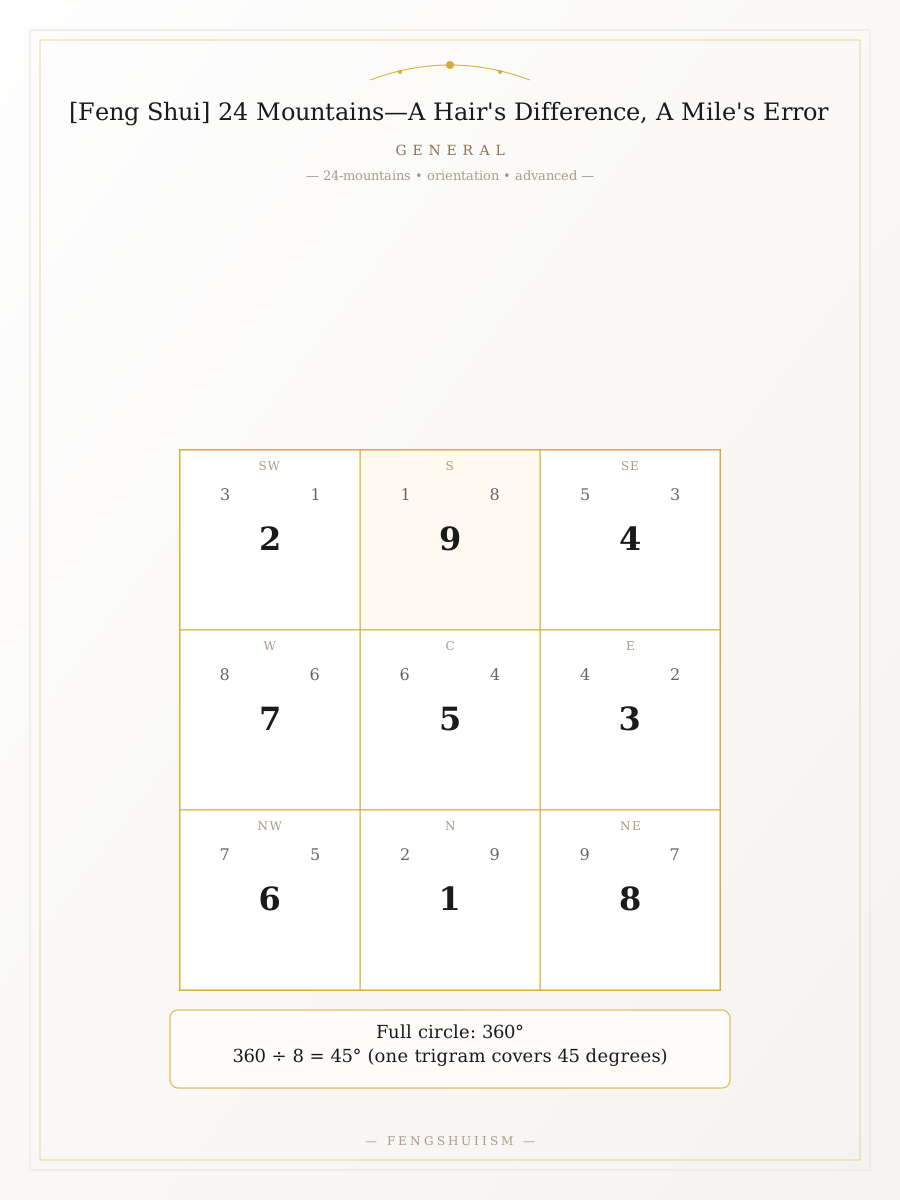
Precise Orientation
Beginner level only discusses 8 directions: East, South, West, North, etc. But in advanced feng shui, this is too coarse.
Deep Analysis: The 15-Degree Secret
- Full circle: 360°
- 360 ÷ 8 = 45° (one trigram covers 45 degrees)
- In Flying Star feng shui, one trigram is divided into three “mountains”: 45 ÷ 3 = 15°
This is the 24 Mountains.
Example: Both “Sitting North Facing South” (Kan House)
Zi Mountain Wu Direction (Due North Due South): This is the emperor’s orientation—extremely powerful energy field. Ordinary people living here might not handle it, easily getting nervous breakdown or even accidents.
Ren Mountain Bing Direction / Gui Mountain Ding Direction (Offset North/South): This is the north-facing direction suitable for common people—gentle and energy-gathering.
Practical Logic: The Trouble with Boundary Lines
If your house’s orientation falls exactly on the boundary between two mountains (like 14.5° ~ 15.5°), feng shui calls this “leaving the trigram” or “void line.”
Symptoms
The compass needle is extremely unstable.
Consequences
Such houses have extremely chaotic energy fields. Residents may experience inexplicable hallucinations, mental instability, or no matter how hard they try, can’t save money.
This is a “dealbreaker” when choosing a house at advanced level.
A Simple Room Test
- Use a professional luopan to measure your home’s precise orientation
- Confirm whether the orientation falls in the middle of a “mountain”
- If it’s on a boundary line, special remedies are needed
FREE TOOL
Discover Your Personal Feng Shui Blueprint
Calculate your Kua number in 30 seconds
Knowledge Layer
Related Wiki Terms
Use these definitions as a quick bridge between the idea you just read and the wider Feng Shui system behind it.
Bagua Map: How to Use the Feng Shui Eight Trigrams in Your Home
八卦
The Bagua divides your home into nine life areas. Learn how to overlay it on a floor plan and activate each zone with intention.
Read definitionFive Elements (Wu Xing) in Feng Shui: Wood, Fire, Earth, Metal, Water
五行
The Five Elements are the foundation of feng shui. Learn the productive and destructive cycles to balance energy in any room.
Read definitionFlying Stars (Xuan Kong Fei Xing): The Complete Guide
九宫飞星
Flying Stars feng shui maps nine shifting energies across your home using a 3×3 grid. Learn how annual stars move and how to activate key sectors.
Read definitionNext Step From This Article
Keep moving from reading into action.
If this article was useful, the best next step is to test one personal direction, one room diagnosis, or the full 2026 bundle.
Personal Direction
Start with Kua Calculator
Use it when you want a personal direction layer before adjusting furniture or work setup.
Open Kua CalculatorRoom Check
Continue with Wealth Finder
Use it when you want to test one room, one entrance, or one likely wealth zone in practice.
Open Wealth FinderFull Plan
Review the 2026 Bundle
Use it when you want a more complete execution-focused package before deciding what to buy.
View 2026 BundleRelated Articles
Bagua Map Explained: Understanding How Directions Affect Your Home
Your floor plan is a 9-grid where each direction relates to different life areas. Learn how to read the Bagua map and work with missing corners.
Read More
Five Elements Feng Shui: How to Harmonize Clashing Elements
Metal clashes Wood? Add Water as a bridge. Fire-Water tension? Add a plant. Learn the 'flow method' to harmonize element relationships naturally.
Read More
Period 9 Feng Shui (2024-2043): Why South-Facing Homes Are Favored Now
Feng shui cycles through periods. From 2024-2043, we enter Fire Period 9—south becomes important. Learn how to align your home with the new era.
Read More